
10 Fragen zum Flaring
-
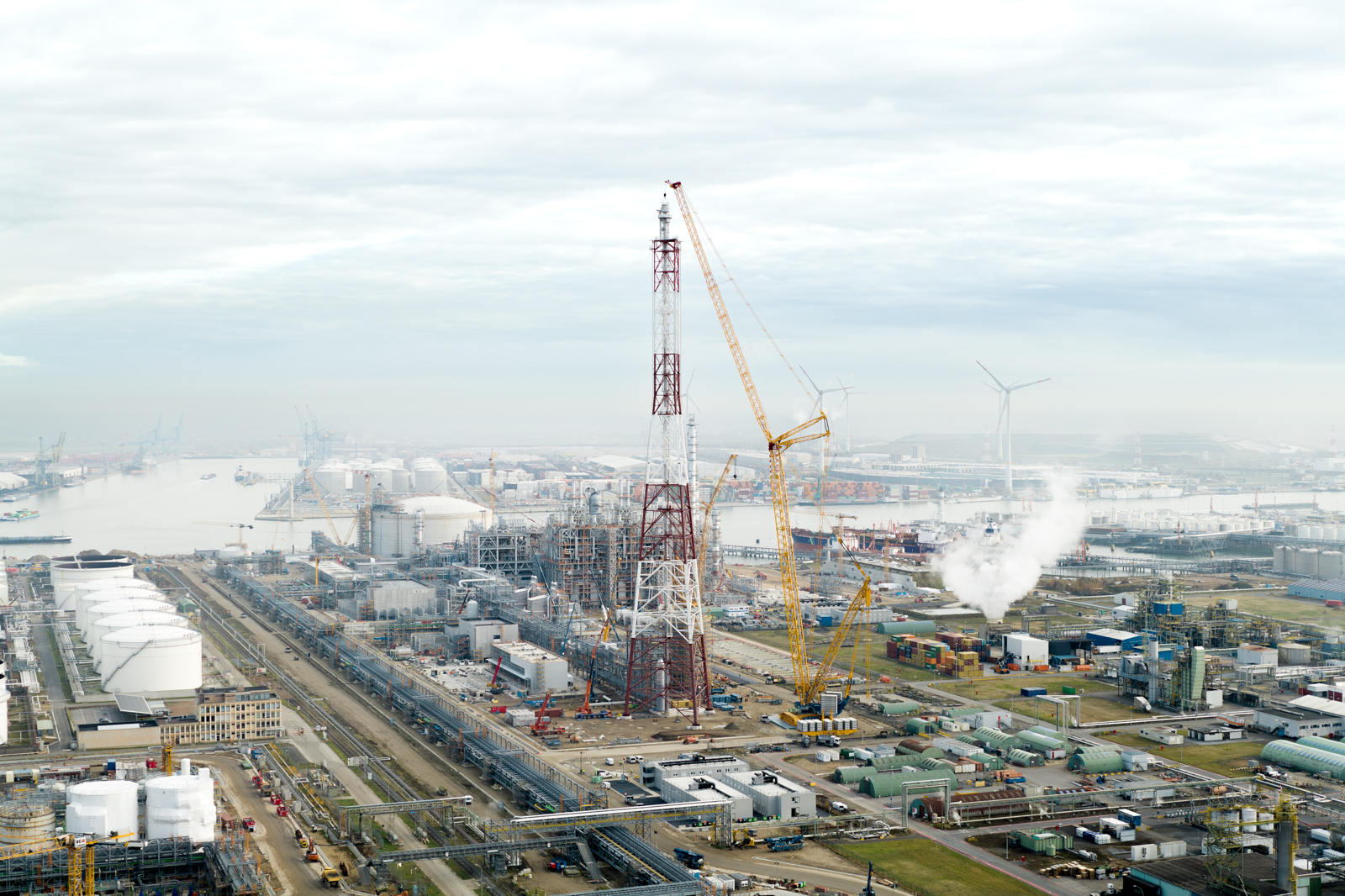
It is a safety device that vents a sudden excess of gas or impurities from the process and burns them off in an environmentally friendly manner.
-
A flare is not a chimney from which smoke continuously escapes. Nor is a flare an incinerator used to burn waste. The less often the flare is activated, the better. After all, valuable raw materials are being burnt.
-
In a chemical plant, flammable gases such as hydrocarbons are often present. These gases are stored under pressure in various vessels. If the pressure becomes too high for any reason, it must be able to escape. This is why these vessels are fitted with a safety valve. This opens when the pressure in the vessel rises above a certain level. These valves are connected to a flare via pipes. Inside the flare, the flammable gases mix with oxygen. Contact with the pilot flame at the top of the flare ignites the mixture. Steam is also added to this mixture to improve combustion.
-
It is normal to sometimes see a small pilot flame at the top of the flare. This is usually fuelled by natural gas. Just as with a gas-fired water heater, the pilot flame serves to ignite the incoming gases. Flares can take many different forms. However, they are all safety devices designed to vent and burn any sudden excess gas in an environmentally friendly manner.
-
In an inactive flare, only the pilot flame is burning. However, you sometimes see a white plume of steam escaping from the top. This is because steam mixes with hydrocarbons when the flare is in operation. It is the oxygen in the steam that ensures complete – and therefore clean – combustion.
-
If the mixture of steam and hydrocarbons is correct, clean combustion occurs, resulting in a bright flame and no harmful substances being released into the atmosphere. The by-products are water vapour and carbon dioxide (CO₂), the same substances that we breathe out.
-
The hydrocarbons must be mixed with enough oxygen to achieve complete, clean combustion. This is achieved by adding steam. A properly functioning flare can be recognised by its bright flame and the absence of a black plume of smoke.
-
If a flare is activated suddenly or in bursts, it is possible that some smoke will emerge for a short while. This is due to a brief lag in the steam supply. This should be avoided as far as possible.
-
For a flare to operate properly, steam must be supplied. This steam is at a pressure of 10 bar. Vibrations and noise occur when this steam is released into the atmosphere. Not supplying steam is worse. This would result in incomplete combustion, producing a black plume and possibly soot.
-
Roel Evens, team lead of the cracker team at INEOS Project ONE, explains all about it in this this video.