

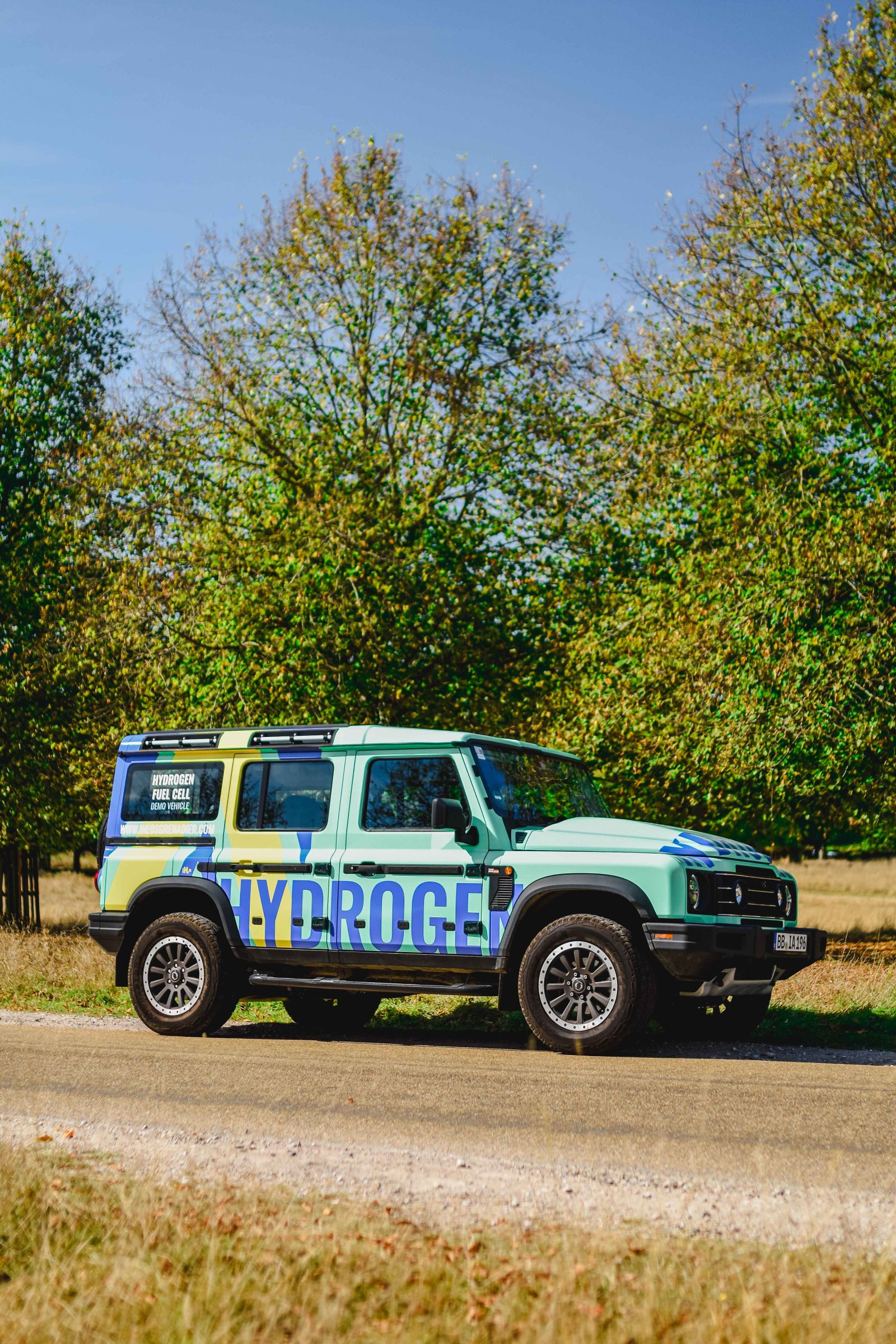
INEOS has built a hydrogen-powered 4x4 to prove its commitment to net zero. It can do everything that a diesel or petrol-run Grenadier can do, but it emits nothing but water vapour.
What’s stopping it hitting the road? A lack of infrastructure in the UK.
HYDROGEN has long been championed as the fuel of the future because it produces zero emissions when used for energy. But it’s also been put on a back burner for years, much to INEOS’ dismay. Now, to demonstrate its own commitment to net zero, INEOS has built a hydrogen fuel cell variant of its 4x4 Grenadier that emits nothing but water vapour.
“It’s an extraordinary vehicle,” said Lynn Calder, CEO INEOS Automotive. “It’s capable of doing everything a conventionally-powered Grenadier can do, but with zero emissions.”
The Grenadier Demonstrator made its global debut earlier this year at the Goodwood Festival of Speed.
It is fitted with BMW Group’s latest hydrogen fuel cell, zero-emissions powertrain, which is considered to be the most advanced and powerful in the car industry.
The project to develop a hydrogen-fuelled Grenadier began in June 2022 with one, clear aim: its on- and off-road capabilities and towing capacities must not be compromised.
To ensure they weren't, the 4x4 underwent rigorous testing, which included the notorious trails of the Austrian mountains and the various offroad challenges around Graz.
Over the years there has been widespread debate about the pros and cons of electric versus hydrogen vehicles.
INEOS Automotive will bring a battery electric 4X4 to market in 2026, but believes there needs to be a mix of powertrains, with different technologies suited to different uses.
Electric batteries are viewed as ideal for city centres and short journeys, but unsuitable for haulage and public transport because of their weight, charging times and range.
Filling a car or truck with hydrogen, on the other hand, is quick and easy. But there just aren’t enough hydrogen refuelling stations.
“Our demonstrator proves that the technology is capable,” said Lynn. “What we need now is support from policymakers to help provide the infrastructure for the next generation of hydrogen vehicles.”
INEOS already produces and uses 450,000 tonnes of low carbon hydrogen every year, the equivalent of replacing up to 2 billion litres of diesel.
The company is Europe’s largest existing operator of electrolysis, the critical technology which uses renewable energy to produce hydrogen for power generation, transportation and industrial use.
“Along with our all-electric model due in 2026, our hydrogen-powered Grenadier Demonstrator shows INEOS’ commitment to net zero and to hydrogen as a key fuel of the future,” said Lynn.