

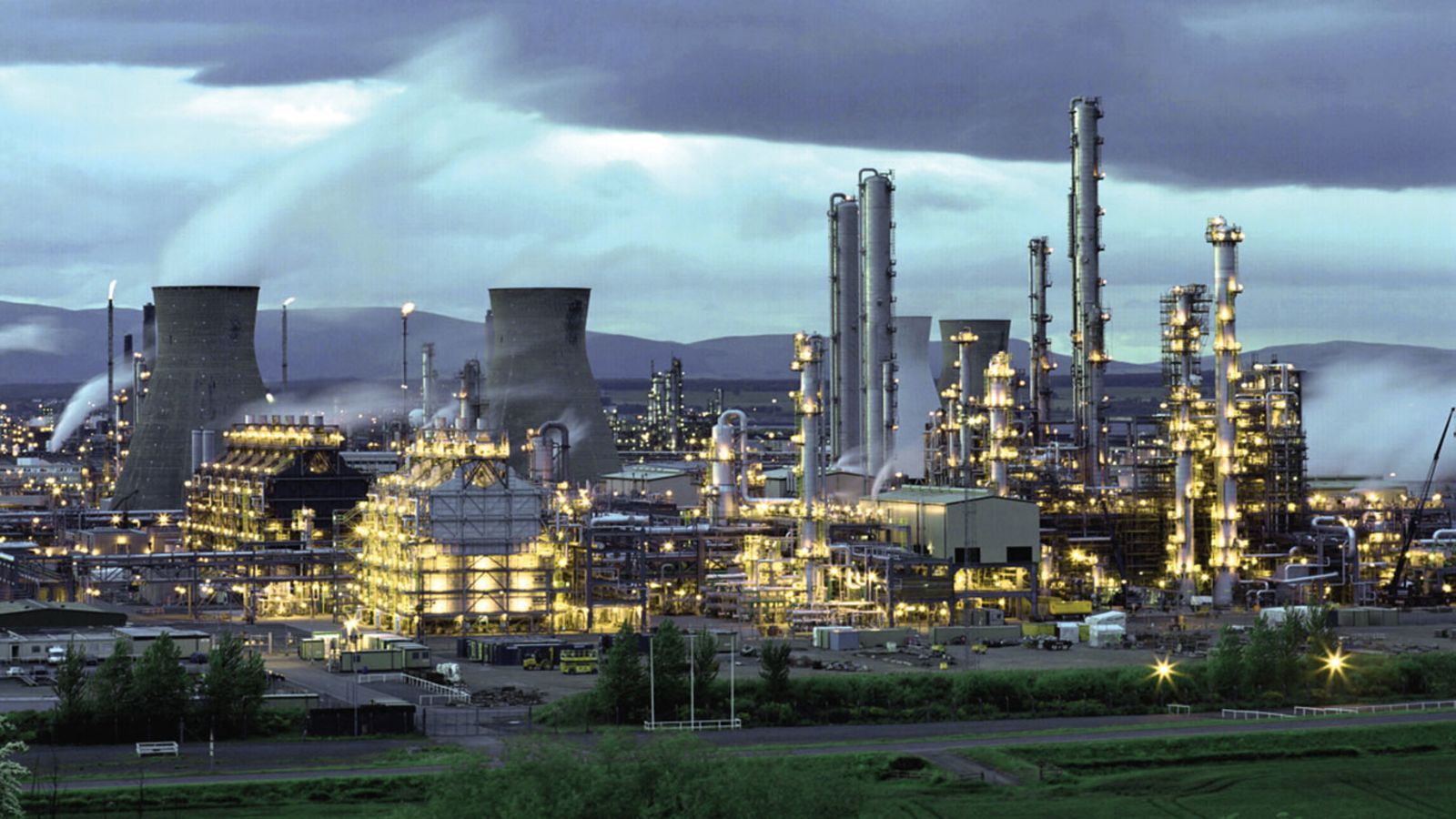
The Grangemouth complex, including the refining joint venture Petroineos, is one of the three largest sites in INEOS. It was built over 50 years ago to process oil and gas from the North Sea.
The site has not performed well since the 2008 crisis and has relied on funding from other businesses in INEOS Group, each year since, to survive. A total of £600m (€715 m) has been funded by Group in this period.
There are two businesses on this complex and each one has its issues. Refining has suffered from a poor business environment in Europe since the crisis and low margins. It also has had poor reliability and high costs.
At the heart of the second business on the site, Chemicals, lies the KG cracker which converts North Sea gases into olefins. These gases have declined rapidly in recent years such that now we can only operate at 50% rates. In addition, the cost base is much too high.
Grangemouth (Chemicals and Refining) has been unable to address its high fixed cost base which has been crippling the business, because the resident union on site, Unite, would not sit down to discuss the seriousness of the situation.
Pensions are a prime example of the uncompetitive position. A typical pension on our Grangemouth site costs 65% of salary. This is simply unaffordable. Salaries are double the national average in the UK. Any attempt to discuss this unsustainable position by the union was simply met with a ‘no’ and a threat of strike action. Unite threatened to strike 3 times in 2013, in February, in July and in September. The 2008 strike cost the business £120m and deprived Grangemouth of much needed investment in infrastructure.
Following a ‘summer of discontent’ over the union convenor, Stevie Deans, who sadly had misused INEOS facilities and information together with mounting losses, we decided that either Grangemouth must accept change or closure.
The only scenario for Chemicals that offered a bright future was to supplement the declining North Sea gases with US shale gas, which is both abundant and cheap. Transporting large quantities of gas however requires investment and infrastructure. It requires special ships and large import and export terminals that can handle liquefied gases at minus 100ºC. The total investment necessary to enable Grangemouth to bring in, and process, US shale gas, is in the order of £300m, of which £150m is required to build the import facility at Grangemouth itself.
INEOS Capital agreed with management before the summer, that it was prepared to fund this ‘transformational’ project for Grangemouth, but only on condition that the business addressed its cost base including the unaffordable pensions and an overall wage package for operators of £100,000 per year (€120,000 or $160,000).
Management constructed a ‘Survival Plan’ for Grangemouth that involved closure of the current pension scheme but replacement with a ‘best in class’ pension scheme, a pay freeze for 3 years and changes in redundancy terms and work flexibility. In return, INEOS agreed to invest £300m to import US gas.
Unite continued to refuse to engage in any discussion on the ‘Survival Plan’ meaning that further losses were inevitable, and further more, that businesses elsewhere in the INEOS Group would have to continue to prop up Grangemouth.
We asked employees to vote on the Survival plan but sadly the result was a split vote.
After much internal discussion following this disappointing outcome, we had little option but to announce closure of the Chemical assets rather than sustain further losses.
At the eleventh hour the union announced a reversal of its position and accepted the requirement for the changes needed to secure the funding of £300m.
Looking back now the outcome was clearly a very positive one for the site. It means that Grangemouth has a future, and potentially a very good and long lived one at that.
It is very regrettable however that the process took the path that it did. It caused distress to employees and families, and it wasted an immense amount of money, over €40,000,000.
It was unnecessary and wasteful. Grangemouth needs to find a constructive way to have a dialogue between employees and management as we do in virtually all of our other sites, whether they are unionised or not. We have had two strikes in recent years at a cost of €200 million, years of aggressive confrontational dialogue with unions, multiple strike threats and heavy losses. The world is a changing place, business fortunes rise and fall. At times there will be need for change and there needs to be an effective forum to discuss this.
I would ask employees at Grangemouth to consider how in the future they would like to be represented in an effective and constructive way, bearing in mind that both employee and employer benefit from a successful future for Grangemouth.
JIM RATCLIFFE