

On 18 September, the EU's first full-scale carbon storage facility was officially inaugurated by His Majesty King Frederik X of Denmark. The Greensand plant is operated by INEOS Energy in partnership with Harbour Energy and the Danish state-owned company Nordsøfonden.
The inauguration was attended by Sir Jim Ratcliffe, President of INEOS, among others.
EU Energy and Housing Commissioner Dan Jørgensen, Danish Minister for Finance Peter Hummelgaard, CINEA Director Paloma Aba Garrote and other representatives from industry and politics in the EU.
About Greensand:
Greensand is a world-leading carbon storage facility and is part of a complete carbon capture and storage (CCS) value chain – where carbon dioxide is captured, transported by ship. And then permanently stored deep under the seabed in the Danish part of the North Sea. The project is led by INEOS Energy, together with Harbour Energy and the Danish North Sea Fund.
- Greensand expects to store up to 400,000 tonnes of carbon dioxide per year during this first commercial phase, and then scale up to the expected 4-8 million tonnes per year at full capacity.
- In this first phase, the carbon dioxide fed into Greensand's value chain comes mainly from Danish biomethane producers.
- A dedicated carbon dioxide terminal in the Port of Esbjerg in Denmark serves as a temporary storage site for liquid carbon dioxide arriving by truck from the capture plants.
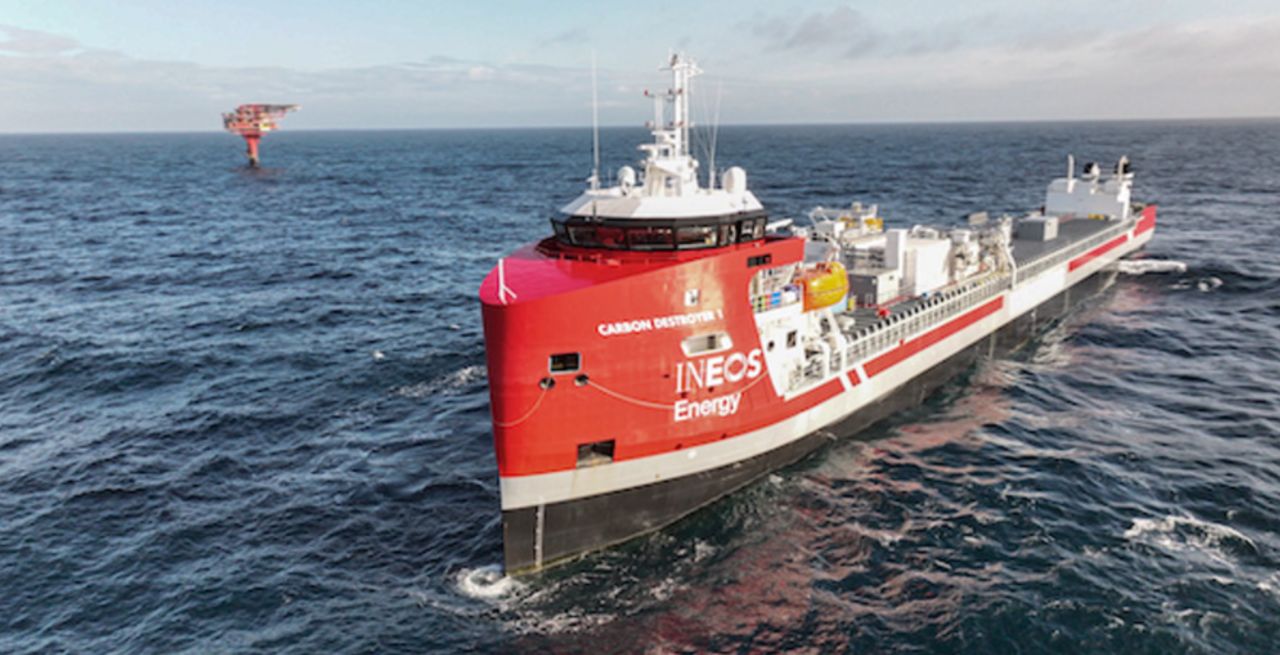
- The carbon dioxide is transported from Esbjerg to the offshore storage site on board Carbon Destroyer 1 – the EU's first purpose-built ship intended solely for the transport of carbon dioxide.
- The carbon dioxide is permanently stored in the Nini West reservoir, a depleted oil field about 250 kilometres off the Danish North Sea coast, about 1,800 metres below the seabed.
Storage and transport are ready – now the collection can begin!
With the inauguration on 18 September, the permanent CO₂ storage will now be fully operational in the EU. The question that is now being asked is how quickly the EU can create the legal, infrastructural and investment conditions that make it possible for industrial emission sources to collect CO₂ on a large scale.
