

CHALLENGE OF A LIFETIME
Extreme adventure taught Abi a valuable lesson.
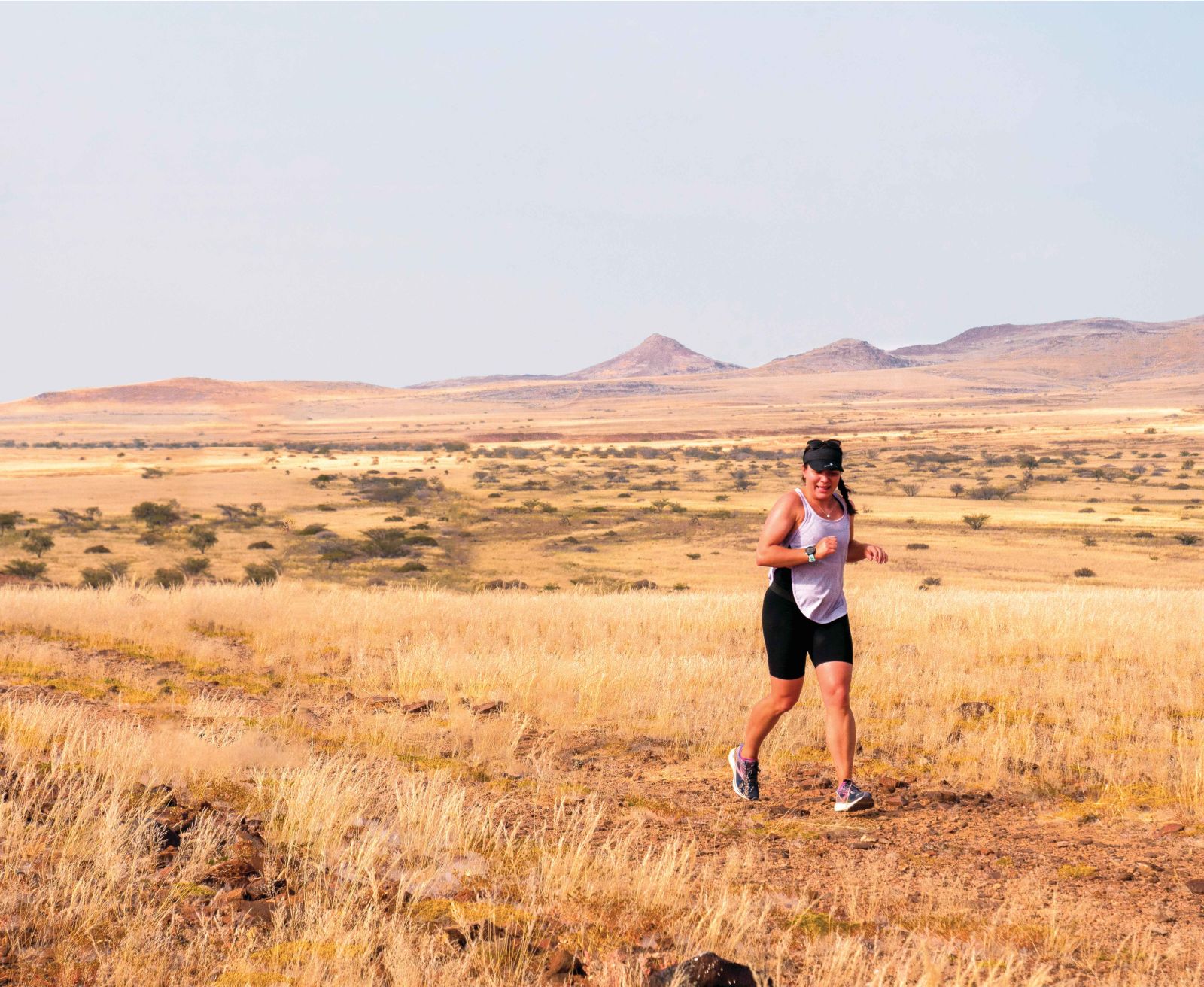
LIFE is full of ups and downs. But since Abi Longhurst returned from the harsh Namibian wilderness, she no longer views that as a bad thing. Nor does she waste valuable effort fretting about what could go wrong. Instead, she has learned to embrace both, thanks to INEOS’ unique IN-NAM desert challenge.
The 320km bike, run and hike through the Namibian desert is billed by INEOS as a life-changing adventure – and the difference it has made to Abi’s life is testament to that.
“The lows made the highs all that more special,” she said. ”For me, IN-NAM was just the beginning. I am now looking forward to more challenges and the highs – and lows – that come with them. The extremes are what make life more engaging and exciting.”
Abi, who is 31, is a process engineer in the asset team supporting the Kinneil Terminal in Grangemouth, Scotland.
The team ensures the plant continues to operate efficiently and safely.
The IN-NAM challenge was launched in 2017.
Each spring INEOS’ third year graduates are offered the chance to find their limits and smash them.
The company believes that by doing that, they will achieve their true potential. It’s all about mindset.
“It is a real test of character and a real adventure,” said Chairman Sir Jim Ratcliffe. “It is something very, very different and INEOS is sort of different. We need people in our company who have got a bit of grit and determination and a bit of character.”
Abi will never forget the six days she spent running, hiking and biking across the world’s oldest desert, nor the feeling of watching the sun rise as she stood on the 8,442ft summit of the Brandberg – Namibia’s highest mountain.
“That moment alone made all the lows training through cold Scottish winters, worthwhile,” she said.
It has changed her life.
“The challenge has left me with a great “why not?” attitude,” said Abi, who is now an ambassador for other graduates wanting to follow in her footsteps.
“I have realised you don’t have to be the fittest or the fastest to take on a physical challenge, and marathons aren’t just reserved for elite athletes.
“I have just completed my sixth marathon, having never run any before the IN-NAM challenge. I have proven that my body can do hard things, and I look forward to pushing my limits further.”
FAITH CONQUERS ALL
Rhys’ epic Everest adventure opened doors
INEOS Chairman Sir Jim Ratcliffe helped to propel Rhys Jones into the history books on May 17, 2006. But Rhys, now 37, didn’t just return from Everest as the youngest person in the world to climb the highest mountains on each continent.
He returned a changed man – with Jim’s words of encouragement and advice still ringing in his ears.
“I had always thought of myself as optimistic and pragmatic,” he said. “But Jim also taught me that if you believe in your goal, you can make others believe in it too.”
His goal in 2006 had been to raise £30,000 so he could climb Mount Everest and complete the Seven Summits Challenge.
His pleas for financial assistance had fallen on countless deaf ears. But Jim was keen to meet the teenager who was prepared to venture into one of the most hostile, unforgiving places on earth in his desire to make history.
“I think he saw someone with a big ambition and the pluck and skill to achieve it,” said Rhys. “And for that, I will always be grateful. It was never about money to Jim.”
With an INEOS flag in his pocket to plant at the summit, all Rhys had to do was overcome rockslides, shifting glaciers, blizzards, freezing temperatures and hurricane-force winds to reach the top of the 29,035ft summit.
“It was the least I could do to repay Jim’s faith in me,” he said.
Rhys succeeded. He made the summit on his 20th birthday to become the youngest person ever to climb the world's highest mountains on seven continents.
Today the born adventurer, who co-founded Monix Adventures, is married and they have a daughter Phoebe. They live among the mountains in the Lake District where he runs school bushcraft camps with wife Laura.
“Climbing Everest when I did, thanks to INEOS, opened a lot of doors for me,” he said. “And to this day that experience provides me with good perspective in what is difficult or not.
“When things are tough, I remind myself that nothing
lasts forever, no matter how steep, how complicated, or how difficult it appears.”
HELP FOR HEROES
THE INEOS Prosthetics Wing at the Defence Medical Rehabilitation Centre in Nottinghamshire is a place of refuge – and hope – for servicemen and women who have lost limbs. For those who work there know that the journey back from injury is tough and demanding.
Dave Wilkinson and Craig Tait are among those currently receiving regular treatment.
“It's had a huge impact on my life,” said Dave. “I have my independence back, I can drive, I am working, I play sports and I can do things with my friends and family.
“There are certain things I cannot do, but focusing on the things I can do, rather than what I cannot do, helps me massively.”
The decision to amputate his lower right leg was made eight years after he badly damaged his foot on a physical training session in Northern Ireland.
Recovery had been slow and incredibly painful – even with surgery.
“After my leg was amputated, I felt instant release,” he said. “The pain had massively decreased and I had the best night's sleep in over eight years.”
Craig was in Afghanistan with the 1st Military Working Dog Regiment when the specialist dog handler fell down a ravine, badly twisting his ankle.
“The ground just gave way,” he said. “I was lucky that our medic was right behind me.”
Initially, he had hoped his leg could be saved, but he too was in huge amounts of pain due to nerve damage so a decision was eventually made to amputate.
“The hardest part was convincing my family,” he said. “But I now have nowhere near the same pain levels as before, and I am more mobile.”
Both men, though, have struggled with being medically discharged from the Army.
“I miss being in the Army nearly every day,” said Craig.
Andy Reid, who was also medically discharged from the Army, lost both legs and his right arm after he stepped on a landmine in Afghanistan in October 2009.
Today he is a passionate ambassador for the Defence Medical Rehabilitation Centre.
“I know from my own experience how important it is to have the right facilities as well as the correct expertise to help people through their rehabilitation,” he said.
In May 2019, he met Sir Jim Ratcliffe after INEOS donated £25.3 million towards the new prosthetics wing to help those, who had lost limbs, get the very best treatment and support.
“The INEOS Prosthetics Wing has been purpose built to get guys out of their wheelchairs, get some legs on and get them walking,” he said.
THE ROAD TO VICTORY
NO HUMAN IS LIMITED. Eliud aimed to inspire everyone to take the brakes off in their heads and believe the impossible is possible.
ELIUD Kipchoge may have made history on the streets of Vienna on October 12, 2019 when he became the first human on earth to run a marathon in under two hours. But behind the scenes was a support staff of hundreds, led by Sir Dave Brailsford, chief mastermind of the INEOS Grenadiers cycling team. And for that, Eliud will be eternally grateful.
“100% of me was nothing compared to 1% of the whole team,” he said.
The 34-year-old Kenyan had come tantalizingly close to breaking the two-hour barrier in Monza, Italy, in 2017.
He knew in his heart – and mind – that it could be done. He just had to convince others it was possible.
In INEOS, a company that thrives on challenge, he found the perfect running partner.
“It was a glorious, glorious challenge, because it had just seemed humanly impossible,” said INEOS Chairman Sir Jim Ratcliffe, who has run more than 30 marathons himself. “When he crossed the finish line, everyone was in tears. It was overwhelming.”
But the INEOS 1:59 Challenge didn’t just write a new chapter in the history of human endeavour.
The work of the INEOS 1:59 Performance Team, supporting Eliud, also created a completely new way to run marathons.
One of the critical elements was the extraordinary formation used by the 41, world-class pacemakers whose main job was to shield Eliud from any wind.
“It was something that had never been done before,” said Dave. “Runners had never run in that formation before.”
Every 5km a new team of pacemakers took over because no athlete in the world could run at the same pace as Eliud without resting.
And the pace was set by an electric car, which had been fitted with a laser that shone a pattern onto the road so the runners could hold their formation.
But the INEOS-backed supporting cast also included scientists, researchers and nutritionists who made sure everything, from the weather to when Eliud ate his last meal, was perfectly aligned.
“It was a meticulously managed and organised event,” said Jim. “And on the day we got absolutely everything bang on.”
The team had left no stone unturned in their quest to help Eliud achieve his goal.
And as he crossed the finishing line in 1:59:40, wife Grace was there to greet him with a hug.
It was the first time she had seen him race.