

The Challenge
This challenge is reflected in the United Nations Sustainable Development Goal 6 (SDG 6), which calls for universal access to clean water and sanitation, and for the protection and sustainable management of freshwater resources globally. SDG 6 highlights that demand for water is rising rapidly due to population growth, urbanisation, and expanding needs from agriculture, industry, and energy production, resulting in water stress that has remained persistently high since 2015, with one in ten people now living under high or critical water stress. The UN also forecasts that without accelerated action, the world will not achieve sustainable water management until at least 2049, underscoring the significant gap between current efforts and required progress.
Against this backdrop, corporate actors, particularly those in water-intensive industrial sectors, have a vital role to play. Companies across global supply chains can help bridge the implementation gap through improved water efficiency, pollution prevention, ecosystem protection, and community engagement. Chemical manufacturers such as INEOS operate in sectors where water is integral to production processes and therefore possess both a responsibility and an opportunity to demonstrate leadership through water stewardship.
Water Scarcity
Water is indispensable to chemical manufacturing, and INEOS has adopted initiatives aligned with SDG 6 to improve water governance and strengthen resilience across our operations. The attainment of these goals in wider society, however, depends upon the materials produced by chemical manufacturing.
Water scarcity is worsening in many regions, with drought risk becoming amplified, reducing water availability, and increasing unpredictability of rainfall patterns. Decreasing water predictability worldwide can undermine health, productivity, biodiversity, and economic stability.
Moreover, 2.2 billion people still lack safely managed drinking water and 3.4 billion lack safely managed sanitation, these are conditions that elevate risks of disease transmission and impede social and economic progress. The UN estimates that achieving universal access to safe WASH (water, sanitation, and hygiene) services in schools by 2030 will require doubling the current rate of progress. That progress is dependent upon the materials produced by INEOS, these materials are needed for pipework, drinking water treatment, waste water treatment and thousands of other elements of the process to contribute to SDG 6.
Water Intensive Industries
For water-intensive industries, responsible water management is both a business necessity and a commercial opportunity. Across our operations, we use water for cooling, processing, sanitation, steam generation, cleaning, and product formulation. INEOS, for example, uses water predominantly for cooling 79.9%, process purposes 16.5%, and steam 3.6%.
Corporate water stewardship today extends well beyond regulatory compliance. It requires holistic management approaches that integrate:
- Risk assessment and mitigation at site and basin levels
- Water use efficiency and technological innovation
- Wastewater treatment and pollution prevention
- Stakeholder and community engagement
- Supply chain due diligence
- Collaboration at the river basin scale
INEOS Water Risk Assessment
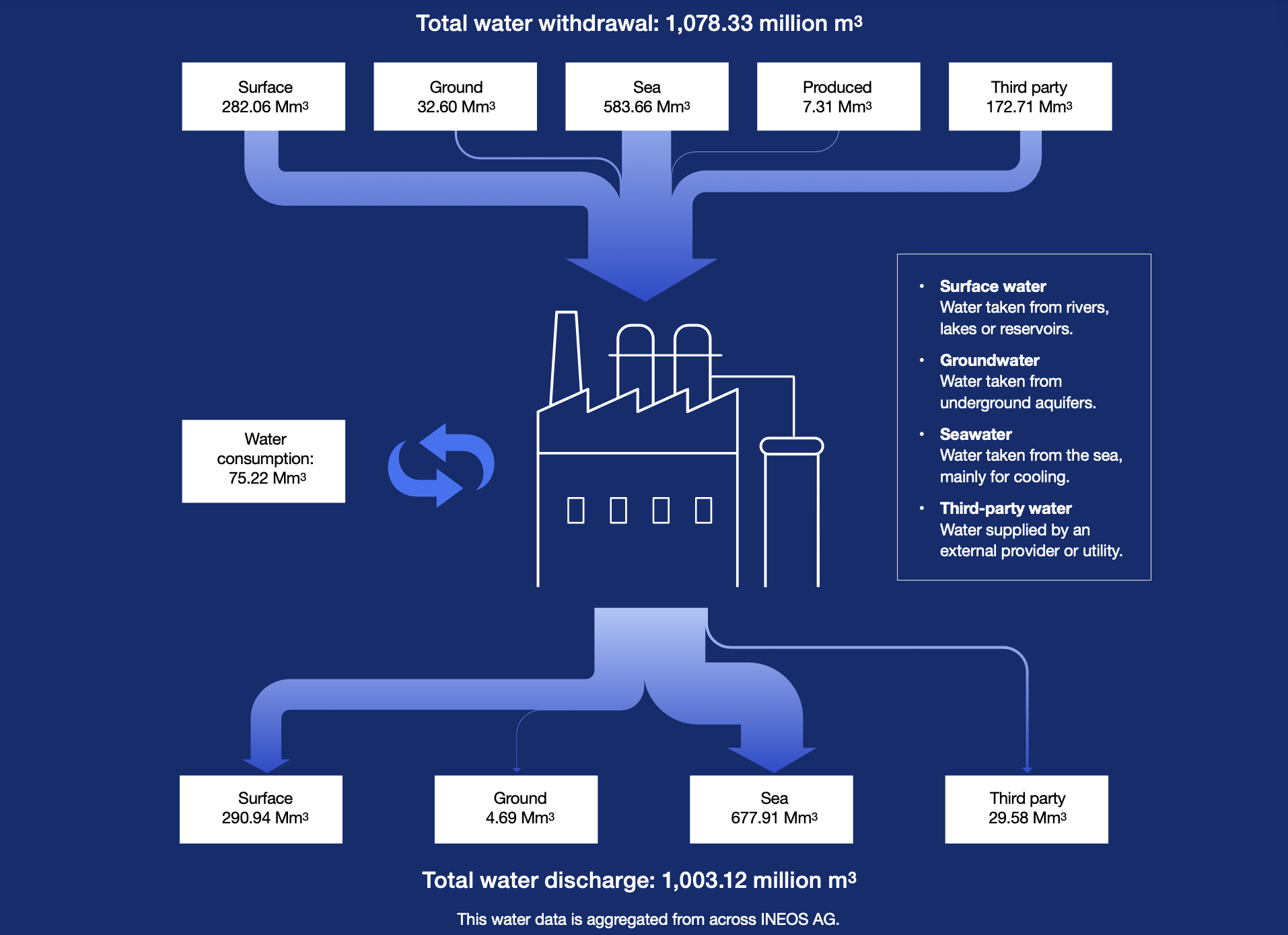
We have large scale freshwater abstraction and discharge across our global operations and have completed a comprehensive water stress assessment of our manufacturing sites that considers water stress, climate change scenarios, future water availability, operational risk, regulatory risk, and specific water withdrawal per tonne of product.
The INEOS water risk assessment applies a structured, three-part methodology designed to identify, quantify, and prioritise water- related risks across our global manufacturing facilities. The process begins with Qualitative Water Risk Screening, which integrates three categories of indicators:
- Global water risk perils
- Country vulnerability, and
- Asset vulnerability.
These indicators collectively form the Facility Water Risk Score, which is used to compare and prioritise sites.
The Global Water Risk dataset that we use assesses external climate and hydrological conditions affecting each site. Key parameters include water quality, arsenic contamination, aridity index, drought duration, water stress, precipitation pattern anomalies, total water storage anomaly, and drought likelihood.
- Data collection and preparation, geocoding, cleansing, enrichment, facility operational data
- Global water hazard screening, water quality, aridity, drought, stress, climate scenarios SSP1/2/5
- Country vulnerability assessment, ND-GAIN infrastructure vulnerability, adaptation readiness
- Asset vulnerability assessment, withdrawals, intensity, dependency, groundwater, seawater, redundancy, recycling
- Weighted composite water risk score, standard deviation weighting, category (hazard/country/asset) weighting
- Prioritisation of high-risk facilities, ranking for deep-dive analysis, supports mitigation planning