Global Policy Landscape
The global policy landscape on waste is evolving rapidly. The UN's 2030 Agenda mandates a profound shift towards the environmentally sound management of chemicals and all wastes throughout their life cycle (SDG 12.4), widespread reduction and recycling of solid waste (SDG 12.5), and the minimisation of marine litter and microplastics affecting life below water (SDG 14).
Simultaneously, international frameworks such as Agenda 21, the Basel Convention, and the Global Declaration for Solutions to Marine Litter emphasise waste prevention, hazardous waste control, circular material flows, and multi‑stakeholder collaboration in tackling plastic pollution at scale.
Within this global context, INEOS has established a robust sustainability strategy in relation to the transition to a circular economy involving the reduction of waste, embedded resource efficiency, and expansion of the use of recycled and renewable materials across its operations.
INEOS recognises that generating unmanaged waste can have material negative impacts on the environment, ecosystems, and communities. Badly managed waste generation contributes to climate change, releases pollutants, destroys resources that could otherwise stay in circulation, and raises significant regulatory and reputational
risks for the business and society. However, external parties are involved in the process and INEOS’ approach to waste, circularity, and
plastics stewardship cannot be implemented by us alone.
We depend upon government policy and other industry sectors to facilitate the supply of recycled materials that we can use as feedstock in our processes. We depend upon materials that are often discarded by people who use those materials to instead be viewed as having value so that they can find their way back to us and go round again.
INEOS’ SHEQ policy and Supplier Code of Conduct mandate resource efficiency, waste minimisation, and responsible waste treatment (including hazardous waste) across all operations and supply chains. Potential actions in our supply chain include:
- Optimisation of process technologies to reduce by‑products
- Water and energy efficiency investments (e.g. closed‑loop cooling, steam recovery)
- Valorisation of residues into secondary raw materials
- Industrial symbiosis schemes within chemical clusters (e.g. Antwerp CHERISH 2O project) to reuse heat, water, and recyclable by‑products
- Substituting virgin fossil materials where possible
INEOS is actively replacing fossil carbon feedstocks where possible with:
- Mechanically recycled polymers
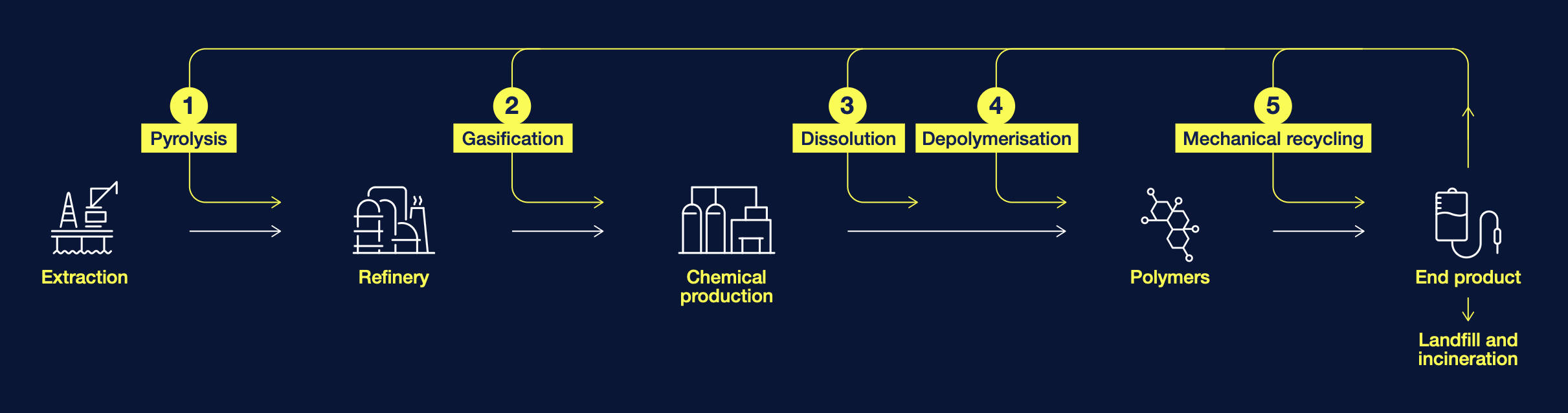
- Advanced recycling feedstocks such as pyrolysis oil and depolymerised monomers
- Bio‑attributed materials
These substitutions significantly reduce product carbon footprints and directly support SDG 12, SDG 13, and SDG 14 targets by avoiding waste, decreasing emissions, and reducing resource extraction.
Portfolio
INEOS has a portfolio of bio-attributed polymers and chemicals, including PVC (BIOVYN), styrenics, epichlorohydrin (REODRIN), phenol, acetone, alphamethylstyrene, and cumene (all under INVIRIDIS), polyolefins, and ethylene oxide. INEOS has strengthened its position in this emerging market with sales of its bio attributed acrylonitrile (INVIREO), which is certified by ISCC PLUS and offers customers ‘drop-in’ performance.
INEOS’ bio-attributed ABS has been selected for well-known toy brands, and INEOS’ bio-attributed high-density polyethylene was used to construct the world’s first bio-based plastic pipeline for transporting gas in Clermont Ferrand.
In addition to these near-term actions, INEOS is investing in R&I to find new pathways to make products from renewable materials in the future.
To date, INEOS has launched more than 30 product grades that contain mechanically recycled content and match the performance of new materials.
This includes the Recycl-IN range of polyolefins that compound mechanically recycled plastic waste with highly engineered virgin resins, as well as the Terluran ECO range of mechanically recycled ABS – both of which offer drop-in performance with up to 70% recycled content. INEOS has also launched a mechanically recycled polystyrene with and is using recycled monomers and feedstock at scale to divert waste from landfill and incineration.
INEOS contributes to the transition to greater circularity in the economy with bio-attributed and recycled products that limit the use of fossil resources, reduce GHG emissions, and create opportunities for customers to meet consumer demand. This is a particular priority for INEOS businesses that make products that reach end consumers, such as polyethylene, polypropylene, polystyrene, and PVC. By moving towards Six Rivers and bio-based materials in this way, INEOS seeks to support increased recycling of plastics. However, to allow us to advance this process we are reliant upon a large-scale reliable supply of recycled feedstock for our manufacturing processes, and straightforward ways for customers to differentiate between products made with recycled feedstock and products that are still made with 100% fossil derived feedstock.
We are dependent upon these factors and without them we will not be successful.
Designing Products for Circularity
INEOS’ Design for Recycling programme focuses on:
- Mono‑material packaging films
- Recyclable polyolefin grades
- High‑performance materials compatible with existing recycling infrastructure
- Collaboration with converters and brand owners to bring circular applications to market.
INEOS participates in the NEXTLOOPP project in the UK to develop tailored, food-grade recycled polypropylene solutions by mixing mechanically recycled polypropylene from the NEXTLOOPP process with virgin polypropylene. INEOS has continued to work with value chain partners to launch new products containing mechanically recycled plastic, such as printers containing recycled polystyrene, headphones containing recycled ABS, and even artificial turf and stadium seating made from Recycl-IN polymers.
During 2025, Indaver supplied INEOS Styrolution with recycled styrene monomer in Antwerp enabling the site to produce fully circular virgin quality polystyrene. Working with partners that specialise in the thermal conversion of plastic waste, INEOS has also trialled recycled feedstock in its Cologne steam cracker, successfully producing virgin-quality circular polymers.
Similarly, INEOS has used recycled feedstock in its Lavera steam cracker to produce virgin quality polypropylene resin, which has been used in flexible food packaging that meets stringent food- contact standards.
Hazardous Waste Management
INEOS manages hazardous waste within strict regulatory frameworks, including ESRS, industrial emissions directives, and national hazardous waste laws. Actions include:
- Rigorous classification and segregation
- On-site and off-site treatment and recovery
- Minimisation of high risk substances and
- substitution wherever feasible
Compliance with REACH, including proactive reformulation to remove PFAS and SVHCs from relevant applications (e.g. bumetrizole removal trials).
This approach echoes Agenda 21 Chapter 20, which highlights prevention, minimisation, safe handling, and controlled transport of hazardous waste as global priorities.
Non-hazardous Waste and Plastics Waste
Non hazardous waste flows primarily include packaging, sludge, process residues, maintenance materials, and plastics.
INEOS seeks to reduce landfill reliance, with actions such as:
- On-site reuse of materials
- substitution wherever feasible
- Enhanced recycling partnerships
- Increasing energy recovery from residuals
- Process changes to reduce waste at source